Phase 3: Findings From Case File Reviews
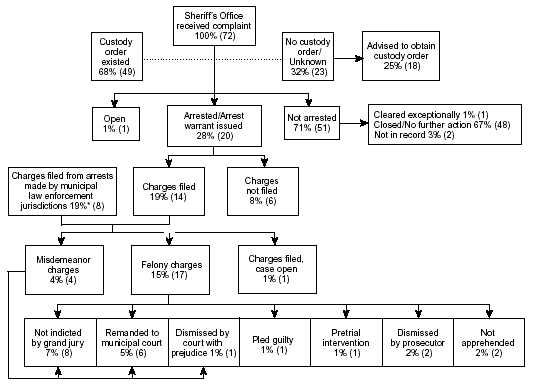
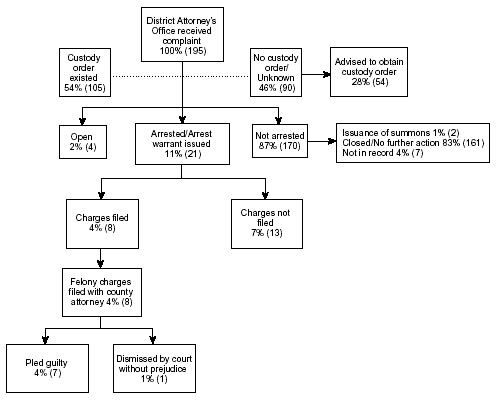
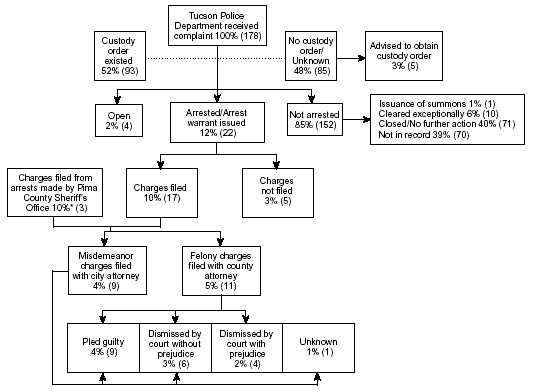
In the study's third phase, the criminal justice system's response to parental abduction was further examined through a review of individual case files in three of the jurisdictions visited during the study's second phase—Hudson, Pima, and San Diego Counties. Individual case tracking produced important findings on the processing of parental abduction cases through the criminal justice system and on case characteristics and their influence on case outcomes. It also corroborated many of the findings of the study's site visits.Conducted in 1995, data collection involved abstracting information from existing paper and computer files in the sites' law enforcement agencies and prosecutors' offices. The final sample included 80 cases in Hudson County (62 from the Sheriff's Office and 18 from the prosecuting attorney's office), 96 cases in San Diego County (all from the District Attorney's Office), and 94 cases in Pima County (80 from the Tucson Police Department and 14 from the county attorney's office).
Figures 1�3 provide an overview of the characteristics and processing of these cases in the three jurisdictions. Researchers considered various characteristics to determine whether they were associated with the response to and outcomes of parental abduction cases—specifically, whether an arrest was made or arrest warrant issued and whether charges (felony or misdemeanor) were filed in criminal court.5 Across all three sites, 74 complaints of parental abduction resulted in arrests or the issuance of an arrest warrant. Fifty of these complaints resulted in the filing of felony and misdemeanor charges.
Four of the twelve perpetrator characteristics examined were found to be positively associated with whether a case resulted in an arrest. That is, cases with the characteristic were more likely to result in the perpetrator's arrest than cases without it. These perpetrator characteristics are listed below:
- Race/ethnicity. Perpetrators identified
as African American, Hispanic, or
"other" were more likely to be arrested
than white, non-Hispanic perpetrators.
- Criminal record. Perpetrators with at
least one prior arrest were more likely
to be arrested than perpetrators with
no prior arrests.
- Prior law enforcement incidents or
complaints between the perpetrator
and complainant. A prior complaint
involving law enforcement increased
the likelihood of arrest.
- History of drug and alcohol abuse. Perpetrators with a history of drug and alcohol abuse, regardless of the source of that information, were more likely to be arrested.
Nine complainant characteristics were examined for their relationship with case outcomes. Four complainant characteristics were associated (either positively or negatively) with arrests or the issuance of an arrest warrant:
- Relationship to the child. Cases in
which child protective services was
the complainant were more likely to
result in the perpetrator's arrest.
- Criminal history. Cases in which the
complainant had a criminal record
were less likely to result in the perpetrator's
arrest.
- History of domestic violence. Cases in
which the complainant had a history
of committing domestic violence were
less likely to result in the perpetrator's
arrest.
- History of mental illness. Cases in which there was an indication of the complainant's past mental illness were less likely to result in the perpetrator's arrest.
One perpetrator characteristic, prior law enforcement incidents or complaints, was found to be associated with the filing of charges by prosecutors' offices. The complainant's history of committing child abuse was also associated with whether charges were filed in criminal court.
None of the characteristics associated with the abducted child (e.g., the number of children involved in the incident or the living situation of the child) was found to be significantly related to case outcomes. This may be attributable in part to the fact that the majority (60 to 78 percent) of cases in all three sites involved only one child.
Six incident characteristics were examined for association with case outcomes; three were found to be significantly related to arrests and arrest warrants:
- The use of a weapon or force.
- The return of the child to the left-behind
parent.
- The removal of the child from the
jurisdiction.
|
|
|
| Previous | Contents | Next |
 |
|
| The Criminal Justice System's Response to Parental Abduction | |