


Recognizing the 20th Anniversary of the Adam Walsh Act
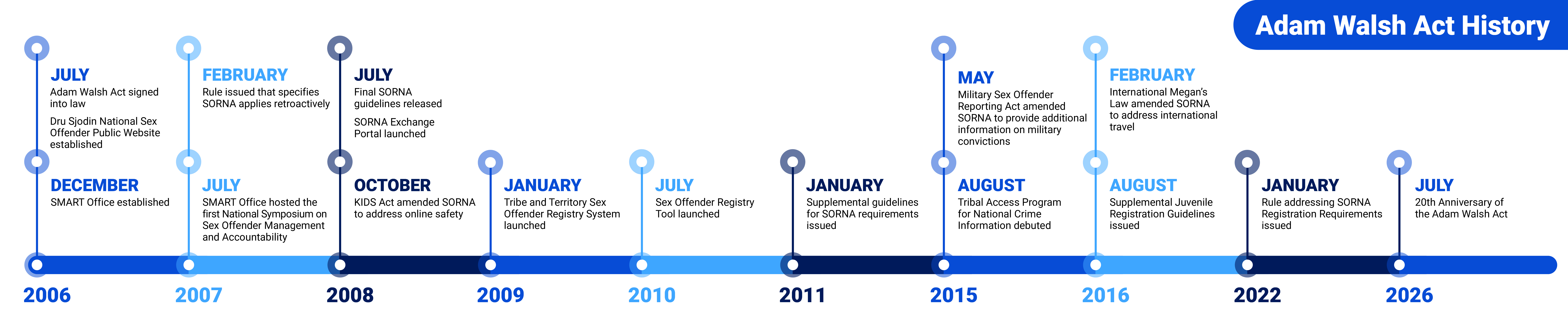
On July 27, 2006, President George W. Bush signed the Adam Walsh Child Protection and Safety Act into law, transforming sex offender registration and notification systems across America.
The Adam Walsh Act expanded on prior legislation by establishing a comprehensive set of national standards for sex offender registration and notification which closed gaps and loopholes that existed under previous laws.
Although registration systems existed in all states and some U.S. territories prior to the Act, many of these systems were not sharing information between jurisdictions. This allowed sex offenders to evade law enforcement detection when moving interstate or internationally.
Historically, registration and monitoring on tribal lands were also excluded from national efforts, creating safe havens and increased risks for tribal communities.
In addition to strengthening sex offender registration systems across the nation, the Adam Walsh Act established the Office of Sex Offender Sentencing, Monitoring, Apprehending, Registering, and Tracking, the first federal office devoted solely to activities related to sex offender registration and management.
Today, the SMART Office continues to lead federal efforts to implement Title I of the Adam Walsh Act, the Sex Offender Registration and Notification Act, or SORNA, by supporting states, tribes and territories’ sex offender monitoring and tracking activities through training and technical assistance, as well as grant funding.
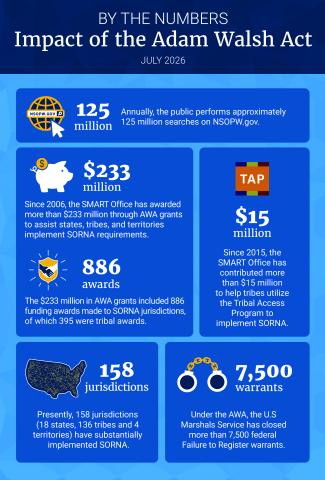
Over the past 20 years, the SMART Office has awarded more than $233 million to assist states, tribes and territories with implementing SORNA’s requirements through the Support for Adam Walsh Act Implementation Grant Program.
Sex Offender Registry Information Sharing
The SMART Office maintains the Dru Sjodin National Sex Offender Public Website, a search engine that connects every jurisdiction’s public sex offender registry. NSOPW provides information to the public at no cost about registered sex offenders in their communities—across state, territory or tribal boundaries.
Today, the public performs an average of approximately 10 million searches on NSOPW.gov each month.
The SMART Office has also helped to advance SORNA implementation through the introduction of additional technological resources, such as the Sex Offender Registry Tool, or SORT, and the SORNA Exchange Portal. These tools are available at no cost and allow jurisdictions to implement SORNA requirements and share information about relocating and traveling sex offenders.
Since launching SORT, seven states and one territory have leveraged the tool to support improved registration systems for those jurisdictions. Additionally, the SORNA Exchange Portal has facilitated the sharing of 233,405 Offender Relocation Tasks between jurisdictions to notify receiving jurisdictions about relocating offenders.
In January 2009, the SMART Office announced the Tribe and Territory Sex Offender Registry System, or TTSORS, a no-cost registry system that allows tribes and territories to manage sex offender registration data without developing or purchasing specialized systems or hardware.
As of 2026, 121 tribes and 3 territories use TTSORS as their sex offender registry system and public registry website.
In August 2015, the SMART Office continued its efforts to help tribes implement SORNA by supporting the launch of the Tribal Access Program for National Crime Information, or TAP.
TAP provides tribes with access to national crime information systems, improving their ability to register sex offenders and protect children in their communities. Since TAP’s inception, the SMART Office has contributed more than $15 million in Adam Walsh Act funding to help tribes utilize TAP to implement SORNA.
As a result, tribes participating in TAP continue to make significant progress toward strengthening public safety and implementing SORNA requirements, including:
- More than 6,300 sex offender entries in the National Sex Offender Registry
- More than 85,800 sex offender modifications of entries in the National Sex Offender Registry
- More than 6,300 orders of protection entered
Ensuring Public Safety Through Cross-Agency Collaboration
Since its inception, the SMART Office has worked closely with its partners, including the U.S. Marshals Service’s National Sex Offender Targeting Center, the Criminal Division’s Child Exploitation and Obscenity Section, and the National Center for Missing and Exploited Children’s Sex Offender Tracking Team, to improve public safety and prevent child exploitation.
Under the Adam Walsh Act, USMS became the lead federal agency to investigate violations of federal sex offender registration laws, assisting state, local, tribe and territory officials locate and apprehend sex offenders who fail to comply with SORNA requirements. The National Sex Offender Targeting Center’s enforcement strategy also includes working with Interpol and the Department of Homeland Security on international travel in adherence with International Megan’s Law.
Annually, USMS conducts over 200 sex offender operations, assisting state and local agencies with sex offender compliance and enforcement across the nation. Since the inception of the Adam Walsh Act, over 5,300 USMS sex offender operations have resulted in more than 35,800 arrests. USMS has opened 51,915 investigations for federal Failure to Register violations under SORNA and closed by arrest more than 7,500 federal AWA warrants.
In addition to enforcement of SORNA, USMS prioritizes sex offense warrants under its fugitive mission. Since 2006, USMS and its fugitive task forces partners have closed by arrest nearly 250,000 felony warrants for fugitives wanted on sex offense, sex assault or failure to register related warrants.
Additionally, several federal efforts to protect children and combat child sexual exploitation and abuse led by the Executive Office for United States Attorneys and the Criminal Division’s Child Exploitation and Obscenity Section have expanded over the last two decades. These initiatives to protect children include Project Safe Childhood, a nationwide initiative to combat crimes involving sexual exploitation and abuse of minors.
These efforts, among others, have contributed to a substantial increase in federal prosecutions involving registry violations. Since the enactment of SORNA in 2006, U.S. Attorneys Offices have filed charges in more than 7,600 cases, resulting in the convictions of at least 6,700 offenders.
Founded by John and Revé Walsh after the death of their son Adam, NCMEC is the nation’s largest private nonprofit organization dedicated to finding missing children, reducing child sexual exploitation and preventing child victimization.
For more than 40 years, NCMEC has assisted in the recovery of more than 480,000 missing children. Notably, NCMEC’s CyberTipline, a centralized reporting system for the online exploitation of children, has amassed more than 240 million reports since it was launched in 1998.
The Future of the Adam Walsh Act
The Adam Walsh Act was designed to protect the public from sexual exploitation and violent crimes through the creation of a comprehensive national system for sex offender registration and notification.
This work continues to evolve as threats to the public evolve. Crimes against children increasingly take place online and across national borders, and SORNA has already adapted to that reality through requiring the inclusion of sex offenders’ internet identifiers and advance notice of international travel.
As technology continues to change how offenders operate, the SMART Office will continue to support jurisdictions to meet their responsibilities under the Act, ensure that communities are protected consistently from one jurisdiction to the next, strengthen systems that require registration information to be shared accurately and quickly among states, tribes, territories and federal partners, and adapt the national infrastructure needed to meet the challenges still to come.