


Research
Assessing a School Justice and Behavioral Health Collaborative Approach to Improving School Safety
Date Published
December 2021
Agencies
NIJ-Sponsored
Publication Type
Program/Project Evaluation

Social Media and Domestic Radicalization
October 2022
Series
Social media has become a potent tool for spreading extremist beliefs and promoting violent extremism. NIJ Social Science analyst Aisha Javed Qureshi joins writer-editor Paul Haskins for a conversation about how scientific research is helping law enforcement and other agencies understand and address this growing concern.
Transcript
Audio file
How Important Is It To Consider Target Properties and Hematocrit in Bloodstain Pattern Analysis
Journal
Forensic Science International
Date Published
September 2016
Agencies
NIJ-Sponsored
Publication Type
Research (Applied/Empirical)
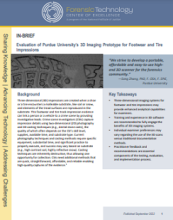
Evaluation of Purdue University's 3D Imaging Prototype for Footwear and Tire Impressions
Date Published
September 2022
Agencies
NIJ-Sponsored
Publication Type
Research (Applied/Empirical)
NMDID: A New Research Resource for Biological Anthropology
Date Published
2019
Agencies
NIJ-Sponsored
Publication Type
Research (Applied/Empirical),
Program/Project Description
Research From Records: Retrieving and Sharing Useful Data From a Non-research Database
Date Published
2019
Agencies
NIJ-Sponsored
Publication Type
Research (Applied/Empirical)
Imprisonment and Reoffending (from Crime and Justice: A Review of Research, Volume 38, P 115-200, 2009, Michael Tonry, ed., - See NCJ-242171)
Date Published
2009
Publication Type
Issue Overview
Factors Affecting Student Success in Postsecondary Academic Correctional Education Programs
Date Published
June 2011
Publication Type
Report (Study/Research)
Can Experts Help Jurors to Evaluate Eyewitness Evidence?: A Review of Eyewitness Expert Effects
Date Published
February 2011
Publication Type
Research (Applied/Empirical)
Interviewing Offenders in a Penitentiary Environment and the Use of Mental Maps During Interviews (From Offenders on Offending: Learning About Crime From Criminals, P 273-289, 2010, Wim Bernasco, ed. - See NCJ-232627)
Date Published
2010
Publication Type
Report (Study/Research)
Added Value Through a Partnership Model of Action Research: A Case Example From a Project Safe Neighborhoods Research Partner
Date Published
2010
Agencies
OJP
Publication Type
Program/Project Description,
Case Study
Truth, The Half-Truth, and Nothing Like the Truth: Reconceptualizing False Allegations of Rape
Journal
British Journal of Criminology
Date Published
November 2012
Publication Type
Research (Applied/Empirical)
An exploratory study of violence and aggression against teachers in middle and high schools: Prevalence, predictors, and negative consequences
Journal
Journal of School Violence
Date Published
2018
Agencies
NIJ-Sponsored
Publication Type
Research (Applied/Empirical)
The Science of School Safety
August 2022
Series
Gun violence may be the most discussed topic surrounding school safety, but it is by no means the only one. Bullying, school climate, and mental health affect students across the country, and are some of the many other issues that NIJ researches. Mary Poulin Carlton, an NIJ social science analyst, joins host Paul Haskins to discuss these and other important school safety issues.
Transcript
Audio file
A Randomized Controlled Trial of a Comprehensive, Research-Based Framework for Implementing School-Based Law Enforcement Programs
Date Published
2022
Agencies
NIJ-Sponsored
Publication Type
Research (Applied/Empirical)
Tribal Crime, Justice, and Safety, Part 2
July 2022
Series
Stacy Lee Reynolds and Christine (Tina) Crossland continue their discussion of tribal crime, justice, and safety, including how Native American persons experience crime victimization at higher rates than non-Native people and the jurisdictional complexities in responding to tribal crime, justice, and safety. Read the transcript.
Listen to the first half of Stacy and Tina’s discussion.
Reading and Resources from NIJ
Tribal-Researcher Capacity Building Grants
Transcript
Audio file