


Victims of crime
Notes From the Field: Collaboration Is Key in Human Trafficking Investigations
Date Published
March 2020
Agencies
NIJ
Publication Type
Issue Overview
Mental Health Response to Mass Violence and Terrorism: A Field Guide
Date Published
2005
Agencies
OVC
Publication Type
Handbook
Mental Health Response to Mass Violence and Terrorism: A Training Manual
Date Published
January 2004
Agencies
OVC
Publication Type
Instructional Material,
Curriculum
Repaying Debts: Report Summary
Date Published
October 2007
Agencies
BJA-Sponsored
Publication Type
Report (Study/Research),
Legislation/Policy Analysis
A Guide to the Role of Crime Victims in Mental Health Courts
Date Published
June 2008
Agencies
OVC-Sponsored
Publication Type
Instructional Material
Responding to People Who Have Been Victimized by Individuals with Mental Illnesses
Date Published
June 2008
Agencies
OVC-Sponsored
Publication Type
Instructional Material
The Co-evolution of Bullying Perpetration, Homophobic Teasing, and a School Friendship Network
NCJ Number
253333
Journal
Journal of Youth and Adolescence
Date Published
December 2017
Agencies
NIJ-Sponsored
Publication Link
Does Educational Success Mitigate the Effect of Child Maltreatment on Later Offending Patterns?
NCJ Number
253276
Journal
Journal of Interpersonal Violence
Date Published
February 2018
Agencies
NIJ-Sponsored
Publication Link
School Climate and Physical Adolescent Relationship Abuse: Differences by Sex, Socioeconomic Status, and Bullying
NCJ Number
253272
Journal
Journal of Adolescence
Date Published
July 2018
Agencies
NIJ-Sponsored
Publication Link
IPV and the Intergenerational Transmission of Violence
NCJ Number
253257
Journal
Domestic Violence Report
Date Published
May 2018
Agencies
NIJ-Sponsored
Publication Link
Patterns of Change in Adolescent Dating Victimization and Aggression During Middle School
NCJ Number
253234
Journal
Journal of Youth and Adolescence
Date Published
2018
Agencies
NIJ-Sponsored
Publication Link
Survivors' Advice to Service Providers How to Best Serve Survivors of Sexual Assault
NCJ Number
253219
Journal
Journal of Aggression, Maltreatment & Trauma
Date Published
2018
Agencies
NIJ-Sponsored
Publication Link
Disputatiousness and the Offender-Victim Overlap
NCJ Number
253210
Journal
Journal of Research in Crime and Delinquency
Date Published
2018
Agencies
NIJ-Sponsored
Publication Link
Victimization, Aggression, and Other Problem Behaviors: Trajectories of Change Within and Across Middle School Grades
NCJ Number
253208
Journal
Journal of Research on Adolescence
Date Published
2018
Agencies
NIJ-Sponsored
Publication Link
Longitudinal Examination of the Bullying-Sexual Violence Pathway Across Early to Late Adolescence: Implicating Homophobic Name-Calling
NCJ Number
253207
Journal
Journal of Youth and Adolescence
Date Published
2018
Agencies
NIJ-Sponsored
Publication Link
Examining the Pathways Between Bully Victimization, Depression, Academic Achievement, and Problematic Drinking in Adolescence
NCJ Number
253180
Journal
Psychology of Addictive Behaviors
Date Published
2018
Agencies
NIJ-Sponsored
Publication Link
Financial Support for Victims of Crime: A Quick Guide for Corrections and Community Supervision Officers
Date Published
August 2018
Agencies
BJA-Sponsored
Publication Type
Report (Technical Assistance),
Report (Grant Sponsored),
Instructional Material
Federal Agencies Work Toward Reducing Opioid Impact on Youth
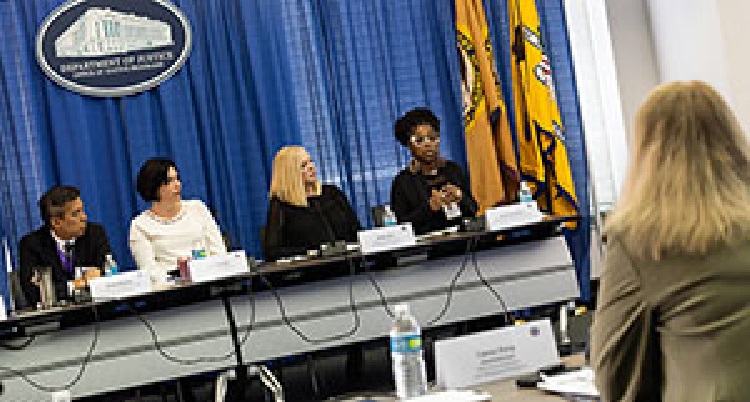
Betty-Ann Bryce, Department of Agriculture (far right), speaks about the impact of drug addiction on rural American communities during a panel discussion at the March 14 meeting of the Coordinating Council on Juvenile Justice and Delinquency Prevention on the impact of the opioid crisis on youth. Listening are fellow panelists (left to right): Ramon Bonzon, Public Health Advisor, Substance Abuse and Mental Health Services Administration; Tara Kunkel, senior drug policy analyst, Bureau of Justice Assistance; and Kellie Blue, associate administrator, Office of Juvenile Justice and Delinquency Prevention. PHOTO CREDIT: (U.S. Department of Justice photo by Paul Adams)
WASHINGTON, D.C. – The anecdotal evidence is staggering: Children as young as 12 raising their siblings because their parents are lost in addiction; kids who learn to count by separating pills for drug-addicted parents; juveniles adjusting to life with sober foster parents after spending years learning to cope with parents who were always high.
These were just a few examples provided by the Department...