


OJP body armor programs keep officers safe on the front lines
The Office of Justice Programs prioritizes officer safety in its grant funding, training and research initiatives.
From body armor performance standards to the Bulletproof Vest Partnership Program, OJP has been a leader in helping law enforcement officers stay safe for more than 50 years, and continues to keep that a priority.
The BVP Program, for example, has seen participation from more than 13,000 jurisdictions since 1999, with a total of $624 million in federal funds for the purchase of more than 1.6 million body armor vests.
Beginning in the early 1970s, OJP’s predecessor agencies led the initial federal efforts to develop protective law enforcement body armor standards that continue to save lives today.
A Deadly Shooting in California
Just before midnight on April 6, 1970, California State Highway Patrol officers Walt Frago and Roger Gore attempted to make an arrest after stopping a vehicle in a Newhall restaurant parking lot.
The driver of the car had reportedly threatened another driver with a gun on the Golden State Freeway.
As Officers Gore and Frago approached the vehicle with their guns drawn, the suspects, Jack Twinning and Bobby Davis — two heavily armed men with long criminal histories — got out of the car and started firing at the officers.
Both Gore and Frago were shot and killed in the shootout.
Only minutes later, highway patrol officers George Alleyn and James Pence arrived on the scene, immediately coming under fire from Davis and Twinning.
In the ensuing gunfight, Alleyn and Pence were also shot and killed.
Davis and Twinning were apprehended within nine hours of killing the four officers, but the tragic Newhall shooting led to a renewed focus on officer safety, including the development of protective body armor, a resource the highway patrol officers didn’t have.
A Push for More Law Enforcement Protections
The Newhall incident was part of a troubling trend in the 1960s and into the early 1970s, with rising reports of police officers killed in the line of duty.
Less than a year after the shooting in Newhall, the National Institute of Law Enforcement and Criminal Justice — predecessor to the Office of Justice Program’s National Institute of Justice — established the Law Enforcement Standards Laboratory at the National Bureau of Standards.
The laboratory was created in January 1971 to help law enforcement identify quality equipment by setting standards for police hardware, including protective gear, body armor, shields, helmets, gas masks and fire-resistant clothing.
At the same time, the Institute initiated a research program to investigate options for lightweight body armor that officers could wear every day.
First Performance Standard Published in 1972
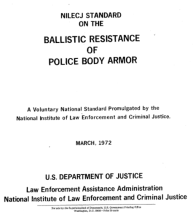
A year after the Law Enforcement Standards Laboratory was created, the NILECJ published its first performance standard for ballistic-resistant police body armor in 1972.
This standard established voluntary performance requirements and ballistic testing methods for body armor to protect officers against small arms fire.
With the search for lightweight body armor ongoing, Kevlar, a durable material manufactured by DuPont to be used in tires, was introduced as a possible solution.
Developing the Kevlar Vest
NIJ chemist Lester Shubin is credited with identifying Kevlar’s potential for soft body armor.
According to reports, when a colleague informed Shubin of DuPont’s efforts to develop Kevlar to be stronger than steel yet lighter than nylon, Shubin asked about its potential to stop bullets.
As Shubin tells the story, “He didn’t know, so we folded some up and shot at it and the bullets bounced off.”
These successful tests led to the creation of lightweight and flexible protective Kevlar body armor for police.
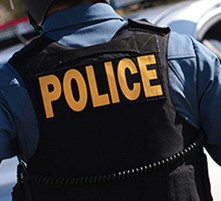
With Kevlar fabric being unavailable in commercial quantities at the time, the Institute contracted with several weavers to produce large amounts of the material. Manufacturers then produced Kevlar vests in accordance with the new design specification.
Between 1971 and 1976, NILECJ allocated more than $3 million to developing Kevlar body armor and funded the creation of 5,000 Kevlar bulletproof vests to be used in a nationwide evaluation program.
First Body Armor “Save” in 1975
Prior to Kevlar, body armor for law enforcement consisted of ballistic nylon, metal inserts, ceramics or laminated fiberglass.
This body armor was used for special situations where threats had been identified. Unfortunately, these materials were generally heavy, hot and conspicuous.
In contrast, the new Kevlar vests were lighter, more flexible and could be worn under normal street clothes.
In 1975, NILECJ initiated a field test and evaluation for the new bulletproof vests that involved 15 law enforcement agencies from across the country.
This field test recorded its first body armor “save” on December 23, 1975, when a gunman shot a Seattle Police Department officer during an armed robbery at a local business.
Over the next year, the Kevlar body armor vests were credited with protecting officers in 18 shootings.
Testing Law Enforcement Body Armor
With the potential benefits of Kevlar bulletproof vests growing, NILECJ launched a body armor compliance testing program in 1978, and the first testing results were published at the end of that year.
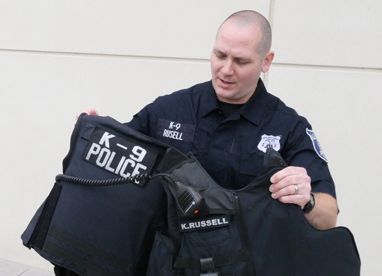
Today, the NIJ Body Armor Standards and Compliance Testing Program helps ensure law enforcement body armor meets the minimum performance requirements aligned with current NIJ standards.
To meet compliance standards, manufacturers submit body armor samples to NIJ-approved laboratories. Once NIJ determines the body armor is compliant, the model is added to a list of approved armor for law enforcement use.
Since its introduction in 1972, the NIJ performance standard for body armor has gone on to gain worldwide acceptance, and has been updated seven times to keep pace with new weapons and ammunition.
Providing Bulletproof Vests to Law Enforcement
Beyond testing the effectiveness of bulletproof vests and setting standards for law enforcement protective gear, OJP also provides funding to police departments across the country to purchase bulletproof vests every year.
The Patrick Leahy Bulletproof Vest Partnership Program reimburses states, local governments and federally recognized Indian tribes for up to 50 percent of the costs of bulletproof vests worn by law enforcement.
Created by the Bulletproof Vest Partnership Grant Act of 1998 and administered by the Bureau of Justice Assistance, the Bulletproof Vest Partnership was OJP’s first internet-only funding application process, which went live in April 1999.
Protecting Law Enforcement with Body Armor Standards
Body armor is a critical tool to protect law enforcement officers.
More than 50 years after initial testing, Kevlar remains one of the primary materials in NIJ-certified bulletproof vests that continue to save law enforcement officers in high-profile situations.
At the April 25 White House Correspondent’s Dinner, a Secret Service agent responding to reports of a gunman was shot in the chest, but the vest he was wearing protected him, potentially saving his life.
It was another reminder of the importance of quality law enforcement body armor. Since the 1970s, bulletproof vests have been credited with saving the lives of thousands of police officers.
Today, OJP remains committed to protecting law enforcement officers with effective body armor through initiatives such as the NIJ Compliance Testing Program and BJA’s Bulletproof Vest Partnership.